One of London’s hidden rivers, the Hackney Brook, flows beneath Stoke Newington – but rewind 200 years and it was visible and up to 10 metres wide.
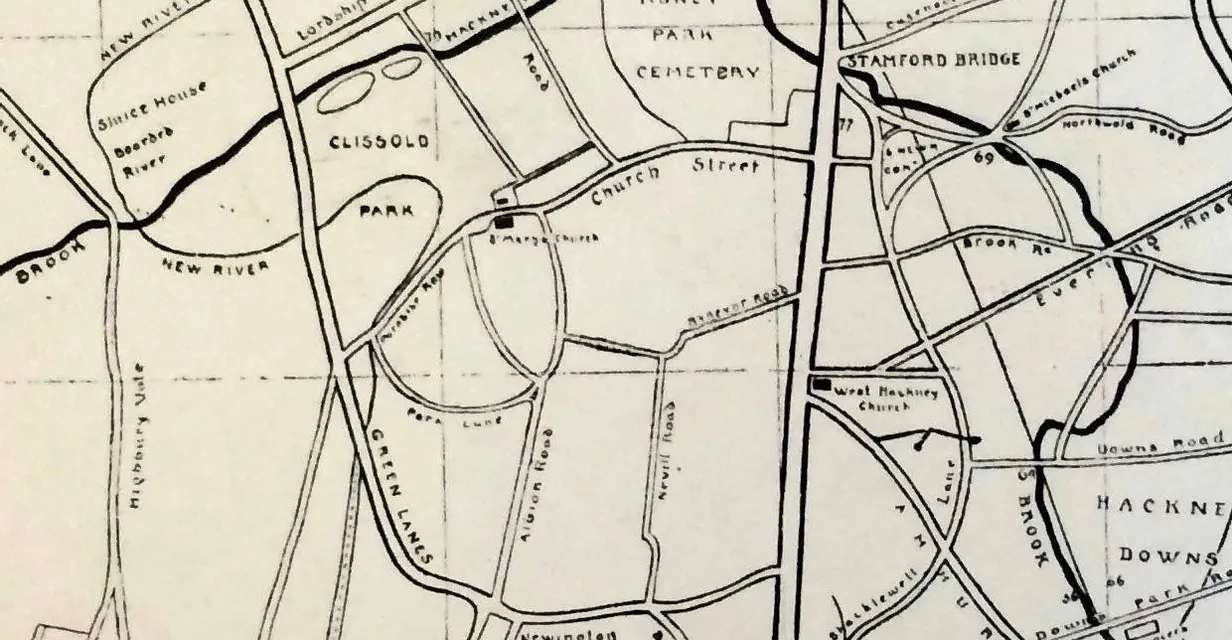
The Brook, which originates from Highbury, was covered over and linked to London’s main sewage system by 1860 to make way for roads, railways and housing. Before that it flowed in the open, cutting across Green Lanes, down the northern edge of Clissold Park (where the ponds are now) and Abney Park, crossing the High St, heading north of Stoke Newington Common and cutting a route via Hackney Downs to the River Lea.
Outside Abney Park Cemetery there was a ford and a crossing called Stamford Bridge (basically a few stepping stones). It’s said that when King James VI of Scotland visited the city in 1603 to be crowned King James I of England, Scotland and Wales, the Hackney Brook flooded his path, forcing him to skirt a wide, muddy lake.
Once described as a ‘clear and purling stream’, grand villas were built along the Brook’s route – though they lost their charm when it degenerated into an open sewer. The creation of an underground sewage system, linked to London’s subterranean rivers was felt by many to be the dawn of a more civilised era.
Among the items found outside the gates of the cemetery as the sewer was constructed were Stone Age implements, (thought to be 200,000 years old) as well as weapons such as swords dating from the 15th century Battle of Barnet during the War of the Roses.
Today, the site at the foot of Stamford Hill still floods periodically, particularly when heavy rain follows a long, hot spell. And locals believe that’s partly due to the subterranean river. This happened in August 2022 when torrential rainfall overwhelmed the water table and brought water gushing up onto roads, pavements and into shops, pubs and homes.
In the 17th century, at the banks of the river in Mare Street (where Hackney Central railway station is now), there used to be a ducking stool where law enforcement took the form of social humiliation. Petty criminals were strapped to a chair on a long wooden beam and dunked into the river!
In his book Stoke Newington, The Story of a Dissenting Village, Rab Macwilliam wrote of the Hackney Brook: “By the 1850s the Brook was travelling through newly built-up areas and had become an unpleasant, disease-carrying open sewer.
“Several street names, such as Grazebrook Road in Stoke Newington and Well Street in Hackney are evocative reminders of the open passage of Hackney Brook.
“In one of its occasional fits of lunacy, Hackney Council in 2016 briefly considered reopening the river between Mare Street and Hackney Wick for purposes of swimming, canoeing and kayaking, but common sense prevailed.”
Local writer Iain Sinclair enlisted the skills of a dowser to trace the river’s route. He wrote: “The Brook is there and, buried or not, it defines the area. You appreciate the reason for the siting of the grander houses, the lost villas and former gardens on the ridge about Morning Lane. You register, despite everything, the hysteria of development, the mess of declining industries, the geological soul of the place.”
Author Peter Ackroyd, wrote: “The 13 rivers and brooks of London still flow. Once they passed through fields and valleys, and now they run along pipes and sewers. But they have survived through the human world. They are buried, but they are not forgotten.”
Do you have any interesting historical facts about the local area? We’d love to hear them at marketing@locationlocation.com.